
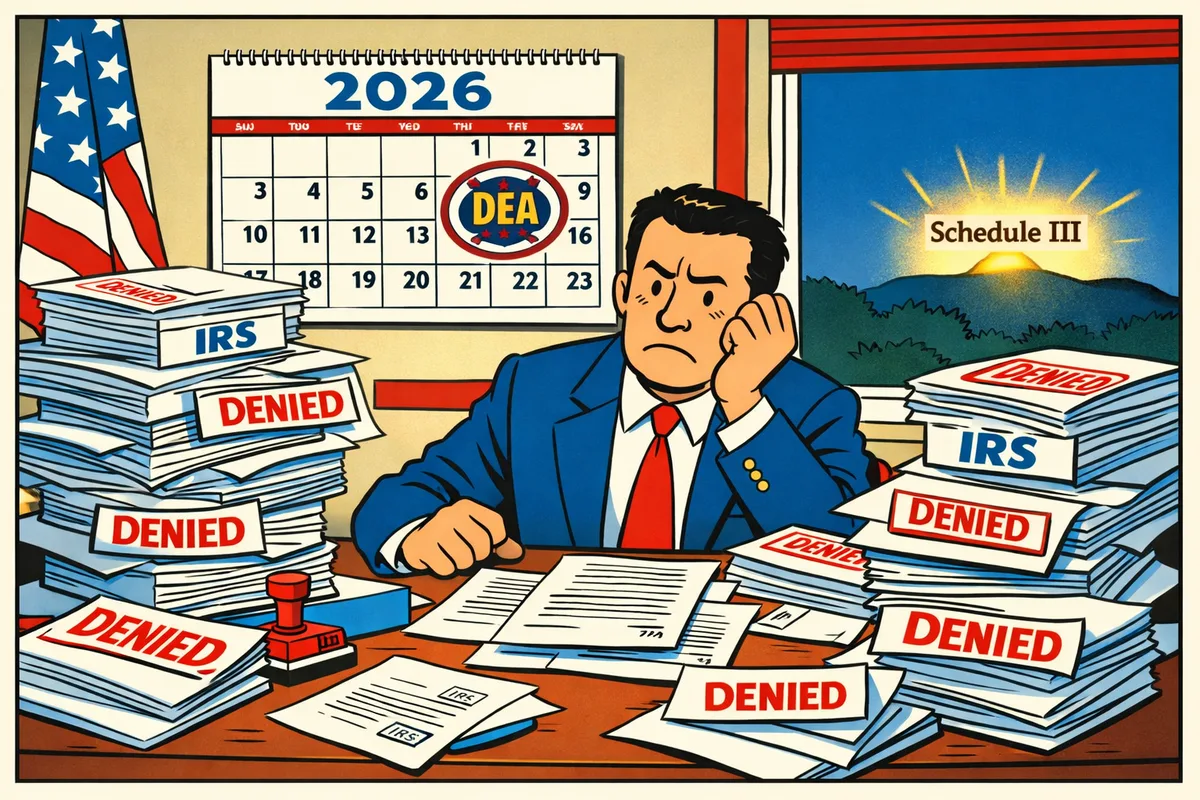
Three months ago, President Trump signed an Executive Order directing the DEA to move cannabis from Schedule I to Schedule III "in the most expeditious manner in accordance with Federal law." The industry cheered. Investors surged. Operators exhaled.
Then the DEA went back to work — and cannabis remained exactly where it was.
Where the Rule Actually Stands
As of March 2026, marijuana is still a Schedule I controlled substance. The executive order does not change the schedule by itself. It directs the Attorney General to expedite the rulemaking process — but that process, governed by the Controlled Substances Act, requires public notice, a comment period, and final publication in the Federal Register.
The DEA confirmed in early January that the rescheduling rule is still in the drafting phase. The current working timeline puts finalization at mid-to-late 2026 — if everything moves smoothly. Legal challenges could push it further.
What 280E Is Actually Costing You
Until the rule is finalized, Section 280E of the Internal Revenue Code applies in full. That means cannabis businesses cannot deduct standard business expenses — rent, payroll, marketing, utilities — that any other industry takes for granted.
The numbers are brutal. A typical cannabis dispensary is estimated to lose roughly $268,000 per year in deductions it can't take because of 280E. For multistate operators running dozens of locations, the annual hit runs into the tens of millions.
The broader industry impact? An estimated $9 billion in annual tax relief is sitting locked behind the DEA's finalization process.
The Gap Between the Headline and Reality
The December 18 executive order got a lot of coverage. What got less coverage: it accelerates the timeline but does not guarantee it. Rescheduling to Schedule III still requires completing the formal Administrative Procedure Act process — and that process has steps that cannot be legally skipped, even by executive order.
One legal expert put it bluntly: the EO "tells the DEA to run faster, not to jump over the fence."
There's also the question of what Schedule III actually solves. Rescheduling does not federally legalize cannabis. It does not open banking. It does not create a federal regulatory framework. What it does — critically — is remove the 280E tax burden and signal to insurers, banks, and institutional investors that the federal posture has shifted.
The Additional Medicare Move
One piece of the December EO that flew under the radar: a CMS policy shift directing that doctors be able to recommend CBD products to older Americans, with Medicare covering up to $500 annually for qualifying individuals — expected to take effect as early as April 2026. This is a separate track from rescheduling and requires no further DEA action.
For medical cannabis operators, this is potentially significant new revenue through insurance reimbursement — a channel that has been effectively closed since federal prohibition began.
What Operators Should Do Now
The advice from cannabis tax attorneys is consistent: model both scenarios. Plan your 2026 financials assuming 280E remains in place through year-end, while preparing to immediately restructure deductions the moment finalization hits. The operators who have the paperwork ready will capture the tax relief faster than those who wait.
Watch for the DEA Notice of Proposed Rulemaking (NPRM) — that's the formal signal that the process is in the home stretch. The industry is targeting Q3 2026 for that milestone. Whether the DEA hits it is another question entirely.
The executive order changed the conversation. The rule change will change the math.