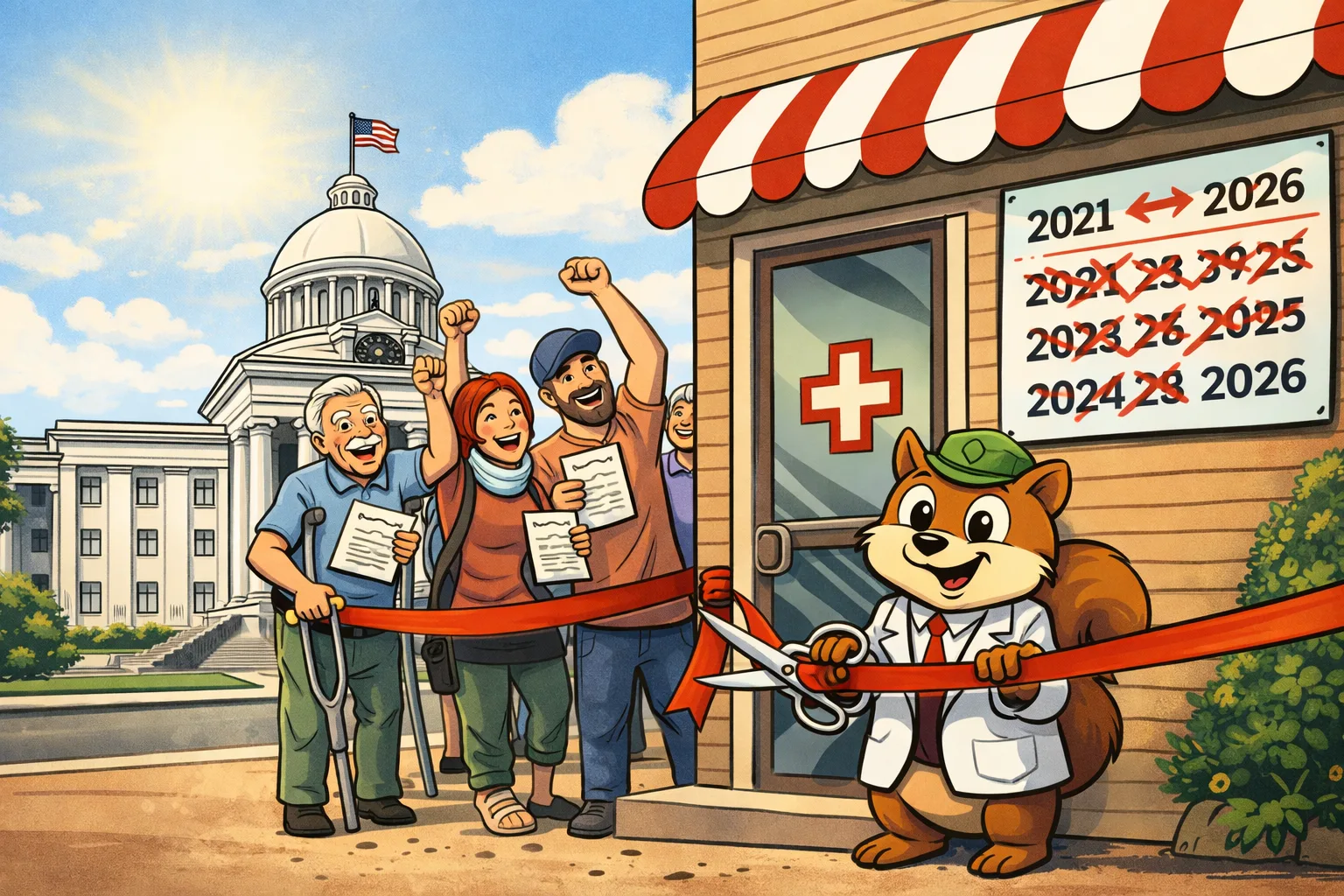
Alabama just became the longest-running punchline in cannabis policy — and it's finally over.
The state approved medical cannabis back in 2021 with SB 46. The Alabama Medical Cannabis Commission (AMCC) was created to issue licenses, set regulations, and get products on shelves. Simple enough, right? What followed was five years of legal warfare that became a textbook case of what happens when rejected license applicants have deep pockets and good lawyers.
What took so long
The AMCC ran its first licensing round in 2023. Applicants who didn't make the cut sued immediately — and won enough injunctions to freeze the entire program in place. The commission had to start over, rerun its scoring process, and defend every decision in court. Alabama circuit courts, then appellate courts, then the Alabama Supreme Court all took turns reviewing whether the AMCC followed its own rules properly.
Three major lawsuits. Multiple do-overs. A licensing process that was supposed to take months stretched across years. Meanwhile, patients with epilepsy, PTSD, chronic pain, and terminal diagnoses waited — legally prohibited from accessing the treatment the legislature had promised them.
What finally changed
The Alabama Supreme Court's final rulings on the outstanding challenges cleared the last legal roadblocks in early 2026. The AMCC confirmed its license holders — a mix of integrated facilities, standalone dispensaries, cultivators, and processors — and set timelines for inspection and product approval. Sales are now imminent.
The product lineup will look different from most states. Alabama banned smokable cannabis entirely. What you can actually buy: gummies, oils, capsules, patches, lozenges, and suppositories. It's the most restrictive consumption menu of any medical state — a political concession to legislators who wanted to separate "medicine" from anything that looked like recreational use.
Who qualifies
The approved condition list is broad: cancer, epilepsy, PTSD, terminal illness, chronic pain, Crohn's disease, depression, anxiety, HIV/AIDS, Parkinson's, multiple sclerosis, and more. Patients need a physician certification, a state-issued medical cannabis card, and a purchase from a licensed dispensary. No home cultivation.
Why this matters beyond Alabama
Alabama is not a cannabis-friendly state. It borders Georgia, Mississippi, and Tennessee — all of which have either no medical program or extremely limited access. Its willingness to stick with implementation despite years of litigation sends a signal: once a state legislature passes medical, the program eventually happens. The courts slow things down; they rarely stop them entirely.
For the multistate operators (MSOs) who secured integrated licenses in Alabama, this is a market opening worth watching. Population of 5 million, a legislature that won't touch recreational for years, and a patient community that's been waiting half a decade. The pent-up demand is real.
What's next
Expect the first dispensary sales within weeks. Price points and product availability will be limited at launch — cultivation operations are just getting their first harvests through the compliance pipeline. The program will look thin in month one and significantly better by Q4 2026.