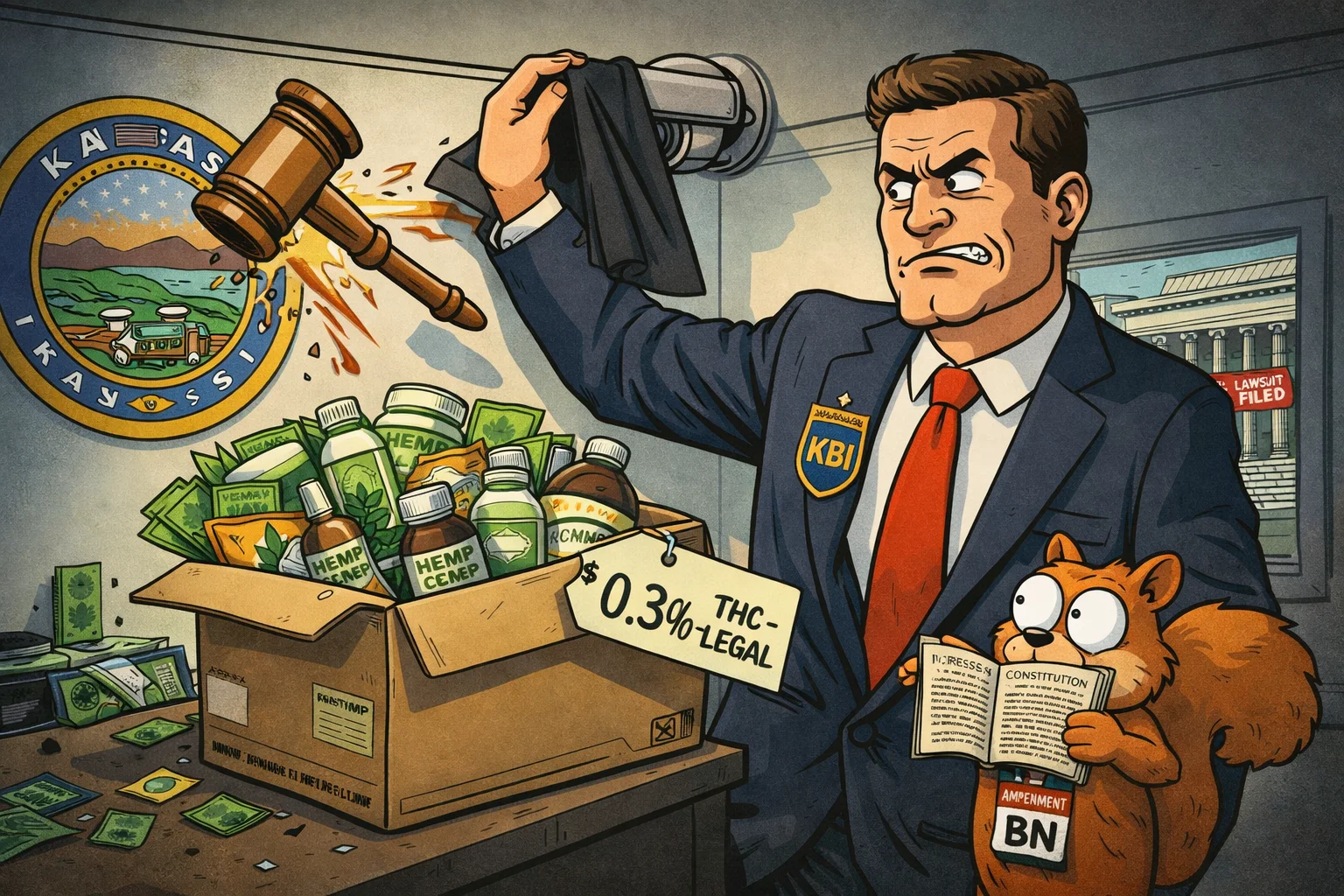
Kansas state officials raided legal hemp shops in eight cities. They covered security cameras, killed the internet connection, and seized inventory. Now they're being sued.
The lawsuit, filed in the United States District Court, names Kansas Attorney General Kris Kobach, KBI Director Tony Mattivi, KBI agents, and county and local law enforcement as defendants. The plaintiffs — Indy Vapes and Abilene Vape and CBD — claim the October 2025 raids violated their Fourth Amendment rights against illegal search and seizure.
What Actually Happened During the Raids
The stores say officers arrived, told employees not to film them, then actively covered windows from the inside, unplugged the store's internet routers, and disconnected in-store security cameras. Then they seized inventory — thousands of dollars in hemp products that the shops had legally purchased from established wholesalers.
Under the Kansas Controlled Substance Act, industrial hemp and hemp-derived products with less than 0.3% THC concentration are not controlled substances. The shops say that's exactly what they were selling. Their argument: if the products were legal, the warrants were defective — and defective warrants make the raids unconstitutional.
Why This Matters Beyond Kansas
This case is a roadmap for how state law enforcement agencies can attack legal hemp businesses without technically banning anything. Instead of changing the law, officials in Kansas used aggressive warrant execution as a weapon — covering cameras, destroying evidence of their own conduct, and seizing products they couldn't easily prove were illegal.
The Kansas Bureau of Investigation's response was telling. KBI said the lawsuit is "a tactic to distract from the fact that Indy Vapes and Abilene Vape and CBD made a business decision to ignore state law." Notice what's missing from that statement: any specific claim about which products were illegal, or what made the warrants valid.
Eight Kansas cities were targeted: Wichita, Topeka, Salina, McPherson, Pratt, Concordia, Independence, and Abilene. The raids affected businesses across the state — not just one shop with one sketchy product.
The Fourth Amendment Question
The shops' lawsuit is a civil action under 42 U.S.C. § 1983, which allows citizens to sue government officials for civil rights violations. The core claim: officials used defective warrants to conduct what amounts to an unconstitutional search and seizure of legal property.
If the federal court agrees, the implications extend far beyond Kansas. Every state where hemp businesses have been raided under similar circumstances would face the same Fourth Amendment scrutiny. That's a significant legal precedent — and exactly why Kobach's office is already trying to reframe this as a PR problem rather than a legal one.
Germany is working through its own regulatory battles over cannabis business structures, as BesserGrowen.de covers in detail — a reminder that legal uncertainty for cannabis and hemp businesses isn't a uniquely American problem.
The shops are asking for damages and a declaratory ruling that the raids were unconstitutional. A decision is months, possibly years, away. But the case is filed. The evidence about covered cameras and unplugged routers is in the record.
Someone decided the way to handle legal hemp businesses was to black out their cameras and take their inventory. Now they're explaining that decision in federal court.